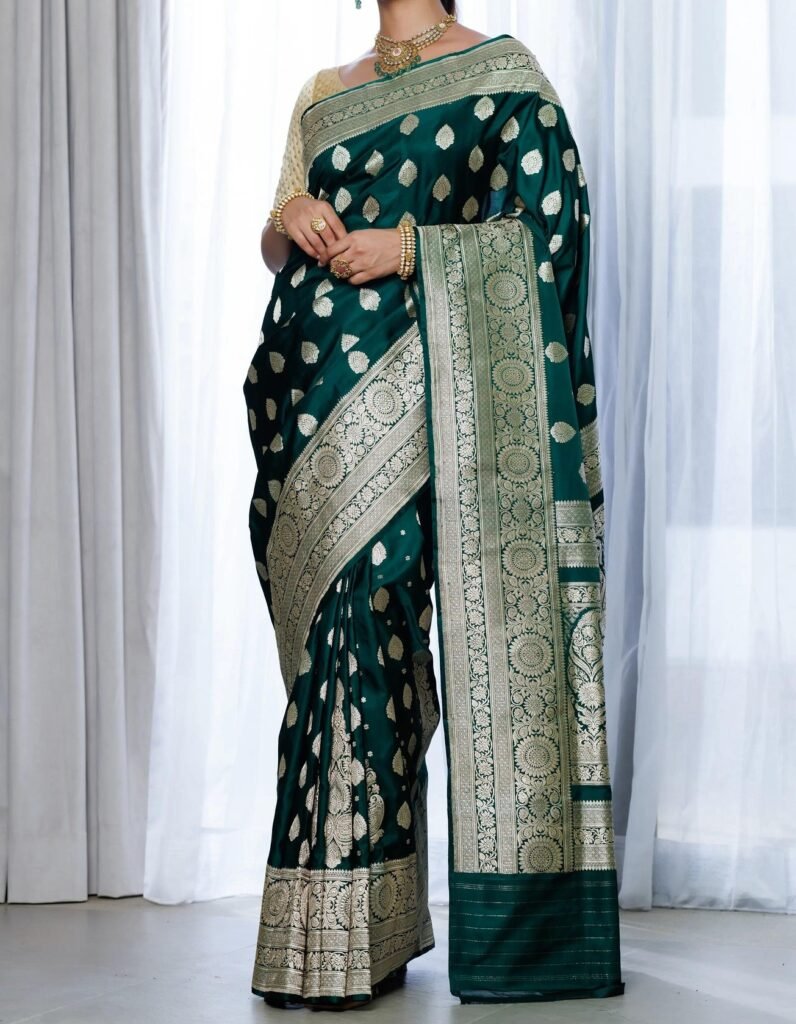
In the fast-paced landscape of 2026 global fashion, where garments are designed, manufactured, and discarded within a single season, one piece of Indian textile art stands as a monumental act of defiance: the Banarasi handloom. Woven in the ancient, labyrinthine alleys of Varanasi (Banaras) in Uttar Pradesh, this heavy, gold-laden drape is not merely a piece of clothing. It is a historical archive woven from silk and metallic threads, carrying centuries of royal patronage, cross-cultural artistry, and absolute mechanical precision.
For generations, the Banarasi silk saree has been the undisputed pinnacle of luxury in the Indian subcontinent. It is the definitive heirloom garment, traditionally passed down from mothers to daughters, preserved in soft muslin cloths, and brought out only for the most significant cultural milestones. But to truly understand why this specific textile commands such intense reverence and such a high price, one must look past its beautiful exterior.
You have to look at the loom, the master weavers, and the mathematical precision required to interlock pure silk with heavy metal wire. Here is a deep dive into the anatomy, history, and craftsmanship of the world’s most regal handloom.
The Convergence of Two Worlds
The visual identity of the modern Banarasi silk saree was not born in a vacuum; it is the spectacular result of a cultural collision. Before the Mughal Empire’s dominance in India, the weavers of Banaras were already renowned for their exceptional cotton textiles and subtle silk weaving. However, the arrival of Mughal royalty brought a massive influx of Persian aesthetics and immense wealth to the region.
The emperors desired garments that reflected their power, leading to the introduction of zari, threads created by wrapping pure silver wire around a silk core, which was then electroplated with pure gold. The Persian influence also completely transformed the weavers’ design vocabulary. Rigid, geometric Indian patterns were seamlessly merged with fluid, sprawling Persian motifs.
Suddenly, the looms of Varanasi were producing fabrics covered in intricate Jal (lattice patterns), Shikargah (elaborate royal hunting scenes featuring elephants and tigers), and the iconic Kalka, or paisley, motif. This hybrid aesthetic created a visual language that was unique to the city, cementing the Banarasi drape as the ultimate symbol of courtly elegance.
The Mechanics of the Pit Loom
The true value of a genuine Banarasi silk saree lies in its agonizingly slow and complex manufacturing process. Unlike modern textiles created on automated power looms in a matter of hours, an authentic Banarasi is woven on a traditional pit loom, requiring the synchronized effort of at least two highly skilled artisans: the Karigar (weaver) and the assistant who manages the jacquard cards.
The process begins long before the first thread is woven. A Nakshaband (pattern designer) sketches the intricate floral or geometric design on paper. This design is then translated into a mathematical code using a series of punched heavy cardboard sheets known as jacquard cards. A single, elaborate bridal saree might require thousands of these punched cards linked together in a massive chain.
Suspended above the loom, these cards dictate exactly which silk warp threads are lifted and which are dropped as the weaver throws the wooden shuttle across the loom. It is an ancient, analog form of binary coding. Because the silk yarn, especially the premium Katan (pure twisted silk), is incredibly fine, and the metallic zari is heavy, the weaver must maintain perfect, consistent tension with every single beat of the loom. If the tension is too loose, the fabric will snag; if it is too tight, the metal wire will snap.
Depending on the density of the gold work and the complexity of the jacquard pattern, a master weaver might only complete two to three inches of fabric in an entire day. A heavily brocaded saree can take anywhere from three weeks to six months of continuous, back-breaking labor to complete.
The Anatomy of the Drape
When you hold a pure Banarasi silk saree, the first thing you notice is the substantial, undeniable weight of the garment. This is not a fragile, floaty textile. It is architectural.
The foundation of the highest-quality Banarasi is Katan silk, where multiple pure silk filaments are tightly twisted together to create a virtually unbreakable yarn. This strong foundation is mechanically necessary to support the sheer volume of metallic zari woven into the borders and the Pallu (the decorative end piece that drapes over the shoulder).
The weaving techniques themselves add to the garment’s texture. The most revered technique is the Kadwa weave. In a Kadwa saree, every single motif, whether it is a tiny golden flower or a sprawling peacock, is embroidered onto the loom independently. There are no loose, floating threads on the reverse side of the fabric. This requires the weaver to stop the shuttle and manually lock the gold thread into the silk base for every single motif, resulting in a fabric that is impeccably clean on the back and highly raised and textured on the front.
Alternatively, the Phekwa technique involves floating the gold thread across the back of the fabric, which is later meticulously clipped away by hand. Both methods result in a textile that catches the light differently than any other fabric in the world, creating a muted, rich luster rather than a cheap, synthetic shine.
The Cultural Weight of the Motifs
The motifs woven into these garments are never random; they carry deep historical and cultural symbolism. The weavers do not simply decorate the fabric; they document stories across the six yards of silk.
One of the most famous patterns is the Jangla design, where the entire body of the saree is engulfed in a dense, continuous scrollwork of vegetation, leaves, and vines. This leaves almost no plain silk visible, creating a heavy shield of gold. The Ganga-Jamuna border is another classic hallmark, featuring two distinctly different colored borders on either side of the saree, representing the confluence of India’s two holiest rivers.
Even the smallest Butis (isolated floral motifs scattered across the fabric) are woven with strict mathematical spacing. Whether it is the Ashrafi Buti (shaped like a gold coin representing wealth) or the Latifa Buti (a delicate, swaying floral sprig), the placement is calculated so perfectly that the garment drapes with flawless symmetry.
Preserving the Craft in the Modern Era
In 2026, the greatest threat to this ancient art form is not a lack of demand, but the proliferation of mechanized power looms. Automated machines can replicate the visual patterns of a Banarasi in a fraction of the time using synthetic polyester yarns and copper-coated plastics instead of pure silk and silver.
However, a machine can never replicate the soul of a hand-woven garment. A power-loom replica feels stiff, plasticky, and lacks the natural, fluid drape of real Katan silk. Furthermore, the synthetic zari on a cheap replica will oxidize and turn black over time, whereas genuine Banarasi zari retains its brilliant, warm luster for generations.
Choosing to invest in an authentic handloom Banarasi silk saree is a direct endorsement of slow fashion and human craftsmanship. It is a refusal to let an ancient, mathematical art form be erased by industrial efficiency. When a woman wears a genuine Banarasi, she is not just wearing six yards of fabric; she is wearing the culmination of months of human dedication, centuries of cross-cultural history, and the enduring legacy of the world’s most skilled artisans. It remains, without question, the ultimate expression of sophisticated elegance.

